
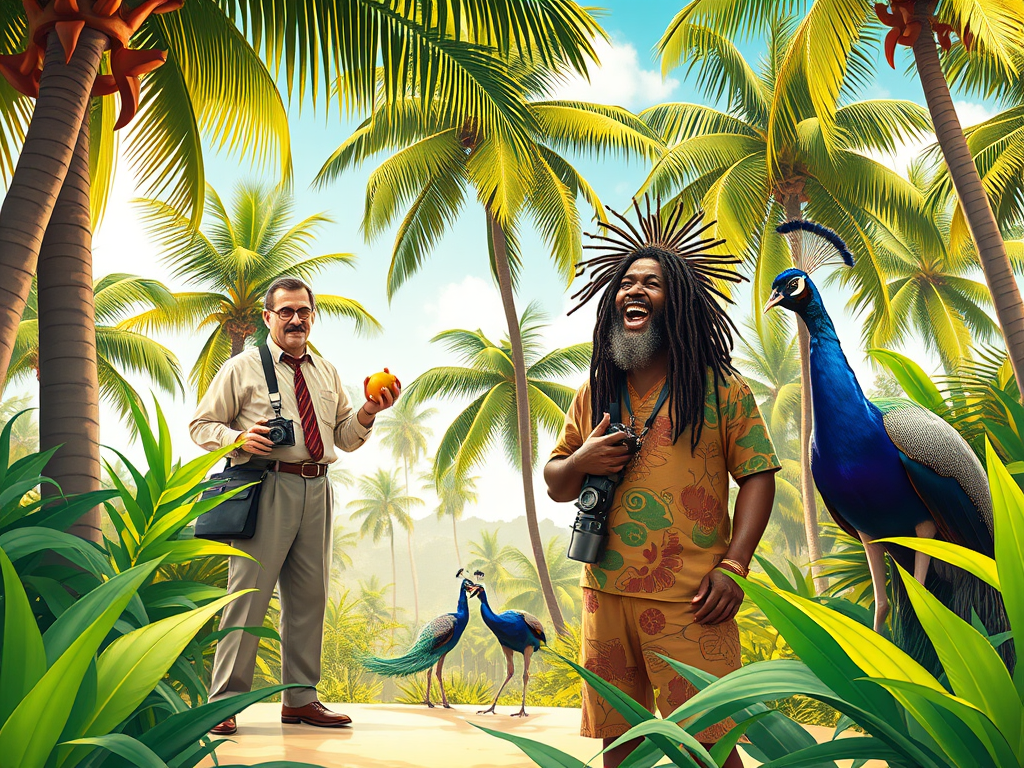

The year was 1962. The Cold War was simmering, threatening to boil over at any moment, and the Caribbean island of Jamaica, newly independent and basking in the sun, found itself an unlikely stage for a comedy of errors starring a bumbling British spy, a Rasta with a penchant for conspiracy theories, and a flock of escaped peacocks.
Our protagonist, if you could call him that, was Reginald “Reggie” Bottomley, a mid-level MI6 operative whose skills were inversely proportional to his enthusiasm. Reggie was sent to Jamaica to “observe and report” on any potential Soviet influence, armed with a camera that jammed more than it clicked and a phrasebook that translated “Where is the toilet?” into “I declare war on your hibiscus.”
Reggie’s cover was as a birdwatcher, a ruse that was almost immediately compromised by his utter lack of knowledge about ornithology. His attempts to identify local species resulted in him mistaking a hummingbird for a particularly aggressive mosquito and nearly being chased up a mango tree by a flock of startled bananaquits.
His first clue, or rather, what he believed was a clue, came from a chance encounter with Brother Isaiah, a local Rastafarian who ran a small fruit stand near Montego Bay. Isaiah, a gentle giant with dreadlocks that defied gravity, was a font of local lore and even more outlandish conspiracy theories.
“Babylon is everywhere, mon!” Isaiah declared one sweltering afternoon, handing Reggie a particularly ripe mango. “Even in de coconuts! Dem Russians, dem sneaky like mongoose, dem hiding missiles in de coconuts!”
Reggie, sweating profusely and swatting away flies, scribbled furiously in his notepad. Missiles in coconuts? This was gold! He envisioned a promotion, a knighthood, maybe even a lifetime supply of Earl Grey tea. He just needed proof.
His attempts to procure said proof, however, were less than stellar. First, he tried to purchase a coconut from Isaiah, insisting on personally selecting the “most suspicious-looking” one, which, according to Reggie, was the one with the most symmetrical dimples. Isaiah, convinced the British were finally cracking the code of coconut espionage, obliged with a wink.
Then came the matter of opening the coconut. Reggie, lacking any discernible survival skills, let alone coconut-cracking expertise, spent the better part of an hour wrestling with the stubborn fruit, armed with a butter knife and the unwavering belief that he was about to uncover a Soviet plot. He finally managed to crack it, showering himself in coconut water and finding…well, just coconut. Disappointed but undeterred, he chalked it up as a clever Soviet decoy.
His investigation took an even more bizarre turn when he decided to stake out a local pineapple plantation, based on Isaiah’s muttered comments about “pineapple power” and “radioactive fruit.” He spent an entire night hiding in a ditch, covered in red dirt and mosquito bites, only to discover that the most exciting thing happening at the plantation was a late-night game of dominoes between the workers.
Meanwhile, chaos was brewing elsewhere. The local British consulate, a stately colonial building with impeccably manicured lawns, was home to a flock of peacocks, descendants of a pair presented to a former governor decades ago. These peacocks were not your average, docile birds. They were notorious escape artists, known for their elaborate disappearing acts and their uncanny ability to disrupt formal events.
One particularly audacious bird, christened “Khrushchev” by the consulate staff because of his aggressive posturing and penchant for squawking loudly at inopportune moments, led a mass exodus from the consulate grounds. The peacocks, a kaleidoscope of iridescent feathers, scattered across Montego Bay, wreaking havoc wherever they went.
They disrupted a cricket match, raided a bakery, and even managed to briefly commandeer a tourist bus, leading its bewildered passengers on an impromptu tour of the local rum distillery. The consulate staff, led by the perpetually flustered Consul Perkins, were in a state of apoplectic despair.
Reggie, still convinced he was on the verge of uncovering a major Soviet plot, stumbled upon the peacock pandemonium while tailing (or rather, trying to tail) a suspicious-looking banana boat. He mistook the iridescent birds for Soviet drones, convinced that their elaborate displays were some sort of coded communication signal.
He attempted to photograph the “drones,” but his camera, as usual, jammed. In his frustration, he kicked a nearby coconut tree, dislodging several coconuts that rained down on the unsuspecting peacocks. The birds, already agitated, retaliated with a flurry of pecks and screeches, sending Reggie scrambling for cover.
He ended up hiding in Isaiah’s fruit stand, convinced he was being pursued by a squadron of Soviet-controlled peacocks. Isaiah, witnessing the spectacle, shook his head in amusement.
“Babylon is truly mad, mon,” he chuckled, handing Reggie another mango. “Dem peacocks, dem just looking for a little freedom, like everyone else.”
Reggie, covered in dirt, coconut water, and peacock feathers, finally began to question his sanity. Maybe, just maybe, he had misinterpreted things. Maybe the Soviets weren’t hiding missiles in coconuts or controlling peacocks with radio waves. Maybe he was just a slightly inept spy with an overactive imagination.
His moment of self-reflection was interrupted by the arrival of Consul Perkins, red-faced and furious, demanding to know if Reggie had seen his escaped peacocks. Reggie, realizing that the “Soviet drones” were actually British property, sheepishly admitted his mistake.
The ensuing conversation was a masterclass in diplomatic awkwardness, culminating in Reggie being ordered to assist in the peacock retrieval operation. The next few days were a blur of chasing peacocks through crowded markets, bribing them with mangoes, and attempting to lure them back to the consulate with recordings of bagpipe music (a strategy that proved surprisingly effective).
In the end, all but one of the peacocks, Khrushchev the ringleader, were successfully rounded up. Reggie, exhausted but oddly satisfied, prepared to return to London, his mission a complete and utter failure.
As he boarded the plane, he saw Isaiah waving goodbye from the tarmac. Isaiah winked and held up a coconut. “Just in case, mon,” he said with a grin.
Reggie smiled. Maybe the Cold War wasn’t quite as serious as everyone thought. And maybe, just maybe, he had learned a valuable lesson about the dangers of jumping to conclusions and the importance of a good coconut. He filed his report, carefully omitting the details about the peacocks, the coconuts, and the mango-induced paranoia. He simply stated that there was “no evidence of Soviet activity” in Jamaica.
Back in London, his superiors were less than impressed. He was reassigned to desk duty, filing paperwork and making tea. But every now and then, when he saw a peacock in the park, he would smile, remembering his chaotic, comical adventure in Jamaica. And he would wonder, just for a moment, if maybe, just maybe, Isaiah was right about the coconuts.



Leave a Reply