
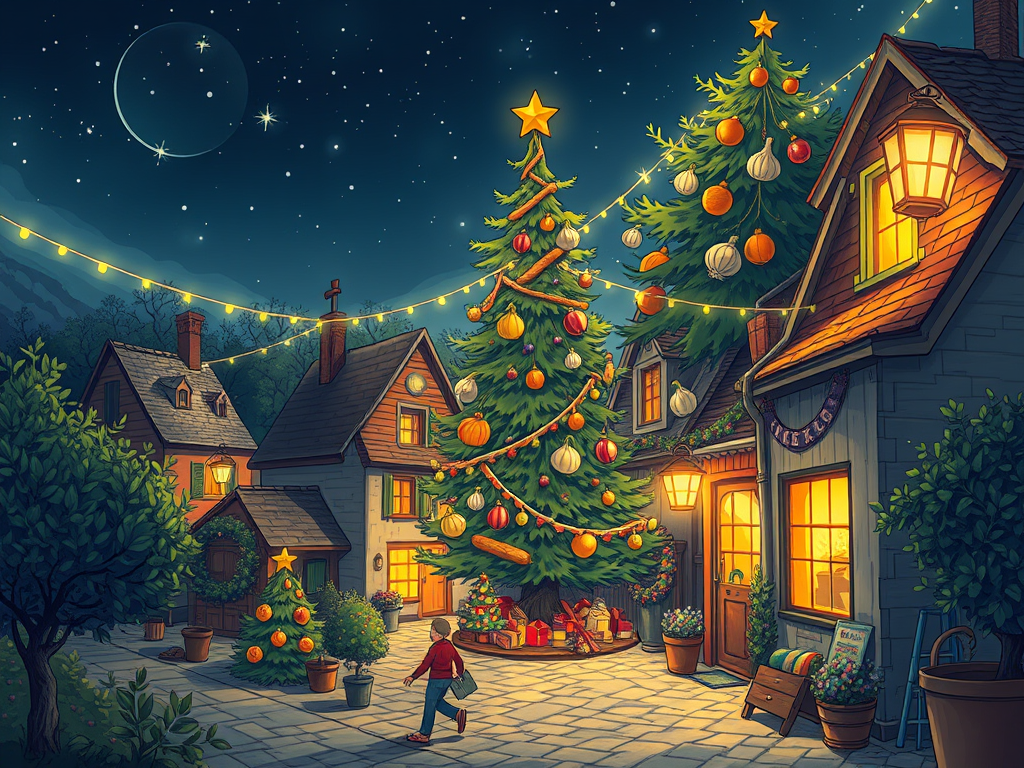

The little village of Saint-Pamplemousse-sur-Mer, nestled somewhere in the south of France where the olive groves meet the grapevines, was usually a picture of peaceful, sun-drenched tranquility. But as December rolled in, bringing with it a chill wind from the Cévennes, a distinct tremor of chaos began to stir. The source? Monsieur Gustave Dubois, the village mayor, a man whose heart was as big as his ambitions, and whose ambitions were usually about three sizes too large for reality.
“This year, mes amis!” Gustave declared at the monthly village council meeting, thumping his fist on the ancient oak table, “This year, Saint-Pamplemousse will not merely decorate for Noël. We shall illuminate! We shall dazzle! We shall outshine that insufferable Bourg-en-Bresse and their perfectly symmetrical, utterly boring spruce!”
A collective sigh rippled through the room. Madame Dubois, Gustave’s long-suffering wife, merely adjusted her spectacles and gave a look that spoke volumes: “Here we go again.”
Gustave’s grand plan was to erect the most magnificent Christmas tree the département had ever seen, powered by a revolutionary, eco-friendly system, and adorned with decorations that screamed “Vive la France!”
Phase 1: The Tree. Gustave, with a flourish, produced a catalogue displaying a majestic “Grand Sapin du Nord.” He ordered the largest model. What arrived three weeks later, strapped precariously to a flatbed truck, was not the stately fir expected. It was a rather spindly, lopsided pine that looked as though it had lost a fight with a very enthusiastic badger. Gustave, undeterred, declared it “authentically rustic! A testament to nature’s untamed spirit!”
Phase 2: The Lights – A Conundrum of Lumens. “No ordinary fairy lights for us!” Gustave announced, puffing out his chest. “We shall have ‘lumières industrielles’ – lights of true power!” A few days later, a pallet of colossal, blindingly bright spotlights arrived. These were not for charming village squares; these were for illuminating football stadiums or perhaps a small moon. Jean-Luc, the village electrician, a man whose primary expression was a permanent sigh, stared at them in horror. “Monsieur le Maire,” he stated, his voice flat, “these will not merely illuminate. They will incinerate the very concept of night. They will blind the entire département!” Gustave beamed. “Precisely! They will see us from Nice!”
Phase 3: The Decorations – A Gastronomic Gaffe. Gustave’s vision for the ornaments was “uniquely Provençal!” He insisted on eschewing traditional baubles. First, he enlisted Brigitte, the baker, to contribute her finest, foot-long baguettes, which were then strung up with twine as edible icicles. “A festive snack!” Gustave declared. Next, he ordered strings of garlic, “for good luck and tradition!” – which merely made the square smell rather piquantly Italian. And for the pièce de résistance: “Our prize-winning Camembert cheeses!” Gustave announced, hefting a particularly pungent wheel. These were carefully hung from the branches, to “add aroma and a touch of local flavour.” Within hours, a flock of unusually bold pigeons had begun to systematically dismantle the baguette decorations, and the warm December air caused the Camembert to ripen with astonishing speed, filling the square with an aroma that made Grand-mère Claudette momentarily believe she’d left her socks boiling on the stove.
Phase 4: Eco-Power – The Pedal Predicament. Jean-Luc had tried to explain that the village’s ancient power grid could barely handle Madame Dubois’s electric kettle, let alone the stadium lights. Gustave’s solution? “We will power it ourselves! With bicycles! A truly green Noël!” He set up a dozen stationary exercise bikes, connecting them to a series of dynamos. The entire village was then obligated to pedal in shifts. This included Grand-mère Claudette, whose pedalling speed was so leisurely that it actually drained power, and young Pierre, whose sugar-fueled bursts of speed caused the lights to flicker violently, like a disco in a thunderstorm.
Phase 5: The Star – A Catapulting Calamity. For the grand finale, Gustave fashioned a magnificent, oversized cardboard star. To place it atop the somewhat confused pine, he enlisted Honoré, the local farmer, who owned a slightly dilapidated tractor with an even more dilapidated hoist. Honoré, having sampled a considerable amount of his own homemade vin chaud, was feeling particularly ambitious.
Christmas Eve – The Great Luminary Lunacy:
The entire village gathered in the square, bundled against the chill. The “rustic” pine sagged under its bizarre load. The baguettes were mostly stumps, the garlic drooped, and the Camembert had developed a personality so strong it could bring tears to your eyes. The papier-mâché escargots, Henri’s artistic contribution, swayed ominously like giant, slimy question marks.
The bicycle-powered lights flickered erratically as the villagers, sweating and groaning, struggled to pedal in unison. Suddenly, young Pierre, fueled by an extra pain au chocolat, pedaled with such vigour that all the stadium lights surged on at once.
The effect was blinding. Everyone gasped, shielding their eyes. The cheese aroma, amplified by the sudden heat, hit like a physical wave. Then, Honoré, with a triumphant cry of “Voilà!”, engaged the tractor’s hoist. The rickety arm lurched upwards, swinging the giant cardboard star wildly. Instead of landing gracefully, it sailed through the air, clipped the sad top of the pine, and descended with uncanny precision, landing squarely on Monsieur Gustave Dubois’s head.
Gustave, transformed instantly into a crumpled, human-sized star, staggered backwards. The impact reverberated through the ground. A string of garlic snapped, knocking down a precarious stack of over-ripe Camembert wheels. They rolled, gaining speed, towards the row of bicycles. The first wheel hit Grand-mère Claudette’s bike, sending her gently tumbling. The second caused a domino effect, taking down the entire line of cyclists and their dynamos.
The stadium lights, with a final, dramatic crackle, shorted out completely. The village square plunged into utter darkness.
A collective hush fell over Saint-Pamplemousse-sur-Mer. Then, from the darkness, a single giggle erupted, quickly followed by another, and then a ripple of chuckles that swelled into an uncontrollable wave of laughter.
Madame Dubois, after untangling her husband from the cardboard star which now sported a rather fetching dent, wrapped him in a comforting hug. “Mon chéri,” she whispered, “it is truly… unique.”
Just then, one of the stadium lights, having experienced its own short-circuit artistic renaissance, flickered back on. But instead of its blinding white, it glowed a soft, warm amber. Then another joined it, illuminating the utterly daft tree in a surprisingly gentle, inviting glow. The nibbled baguettes looked less sad, the escargots almost whimsical, and even the “aroma” seemed part of the charm.
And as if on cue, Jean-Pierre, the village accordionist, who had been hiding behind a stall after his polka carols were universally booed, started playing a simple, melancholic, yet utterly charming French carol. The whole village, still chuckling, joined in, their voices carrying on the crisp night air.
Gustave looked around, a faint smile on his face. It wasn’t the dazzling spectacle he’d envisioned. It was ridiculous, messy, a little bit smelly, and utterly, unforgettably theirs. Bourg-en-Bresse’s perfectly symmetrical tree and polite carols suddenly seemed terribly boring.
From that day on, Saint-Pamplemousse-sur-Mer’s Christmas tree was always a little bit daft, a little bit chaotic, and always powered by a rotating cast of slightly bewildered but very good-humored cyclists. And every year, a cardboard star mysteriously found its way onto Monsieur Dubois’s head at some point during the celebrations, which he wore with a proud, if slightly lopsided, smile. For in Saint-Pamplemousse, a daft Christmas was simply the very best kind.

Leave a Reply