

The Gilded Cage
The year is 1867. London sprawls, a monstrous beauty choked with the smoke of industry and the stench of desperation. In the hallowed halls of Westminster, gas lamps cast a flattering glow on the faces of men debating matters of the Empire, oblivious to the festering wound it concealed. Among them was Lord Ashworth, a man whose privilege was as deeply ingrained as the grain in his mahogany desk.
Ashworth was a man of considerable breeding and even more considerable wealth. He’d inherited his title and fortune, a life meticulously crafted by generations of Ashworths to ensure ease and influence. He’d never known hunger, never known fear beyond the social faux pas, never known the sting of real hardship. He was, in short, a perfect embodiment of the disconnect between the governing class and the governed.
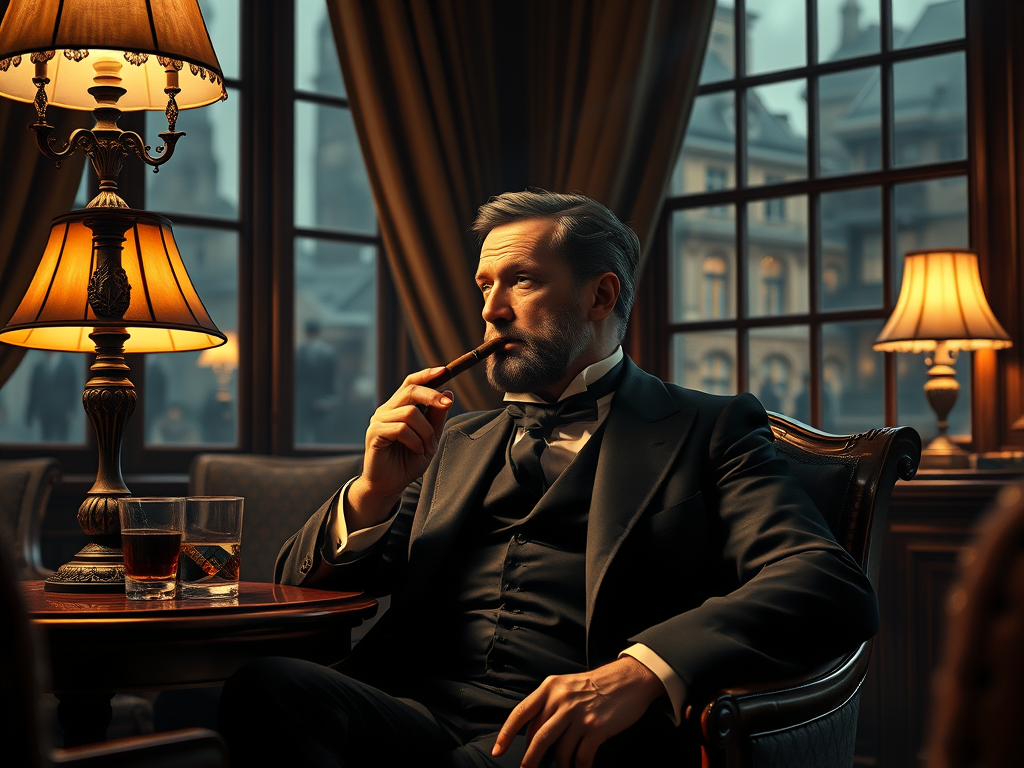
He sat in the smoking room, puffing thoughtfully on a Cuban cigar, the aroma mingling with the heady scent of brandy. Around him, other parliamentarians engaged in similar pursuits, their voices a low hum punctuated by bursts of laughter and pronouncements of self-importance. The debate in the House had been tedious, something about tariffs on imported textiles. Ashworth hadn’t paid much attention. He knew how he’d vote – along party lines, of course. Independent thought was a dangerous luxury in politics.
His friend, Lord Harrington, a man whose face was as weathered as an old saddle, slapped him on the back. “Ashworth, old boy! You look positively contemplative. What’s troubling your mind?”
Ashworth took a long drag of his cigar, the smoke curling around his face. “Just… the state of things, Harrington. This relentless drive for industrial progress. Are we truly benefiting everyone, or merely lining our own pockets?”
Harrington chuckled, a dry, rasping sound. “Sentimentality, Ashworth? At your age? Don’t tell me you’re developing a conscience.” He took a swig of brandy. “The lower classes need employment, and the factories provide it. They’re better off than they were scratching a living from the land.”
Ashworth frowned. He’d seen the reports, the statistics on infant mortality, the overcrowding in the slums, the rampant disease. He’d even, on a dare during his university days, ventured into the East End. The memory of the squalor, the desperation in the eyes of the people, still haunted him.
“But the conditions, Harrington,” he said, his voice barely a whisper. “The poverty… the crime…”
Harrington waved a dismissive hand. “A necessary evil, Ashworth. A small price to pay for progress. Besides,” he lowered his voice, “a little crime keeps the police employed, doesn’t it? It’s all part of the delicate balance.”
Ashworth wanted to argue, to voice the unease that gnawed at him, but he knew it was futile. Harrington, like most of his colleagues, was insulated from the realities of the situation. They lived in a gilded cage, surrounded by comfort and privilege, their lives untouched by the hardship that plagued the majority of the population.
He sighed and took another puff of his cigar. “Perhaps you’re right,” he said, the words tasting like ash in his mouth.
Meanwhile, in the labyrinthine alleys of Whitechapel, a different drama was unfolding. Eliza, a young woman barely out of her teens, huddled in a doorway, shivering against the biting wind. Her clothes were threadbare, her face pale and gaunt. She clutched a loaf of stale bread, her only sustenance for the day.
She had come to London with dreams, lured by tales of opportunity. But the reality was far harsher. The factories were overcrowded, and the work was grueling and poorly paid. She’d lost her job months ago after contracting a lung infection, and now she was reduced to begging and scavenging.
Every day was a struggle for survival. She had seen things no young woman should ever see: violence, exploitation, and the slow, agonizing death of hope. The police were indifferent, more interested in maintaining order than helping those in need. Justice was a luxury for the rich.
She watched as a group of men, their faces hardened by poverty and desperation, gathered in a nearby alleyway. They were members of the “Black Hand,” a criminal gang that preyed on the vulnerable. They offered protection, but at a price – a price Eliza couldn’t afford to pay.
The leader of the gang, a hulking brute named Silas, spotted her and approached, a predatory gleam in his eyes. “Well, well, look what we have here,” he said, his voice a low growl. “Little Eliza, all alone and hungry.”
Eliza backed away, clutching her bread tighter. “Leave me alone, Silas.”
Silas chuckled. “Why would I do that? You need help, don’t you? Protection.” He reached out and grabbed her arm. “For a small fee, of course.”
Eliza struggled, but she was no match for his strength. He dragged her into the alleyway, his grip tightening on her arm.
“No!” she cried, her voice lost in the cacophony of the city.
Across town, in his opulent drawing room, Lord Ashworth was hosting a dinner party. The table was laden with delicacies from across the globe, the wine flowed freely, and the conversation sparkled with wit and erudition. His guests, all members of the political elite, discussed the important matters of the day – the Irish Question, the expansion of the railways, the latest gossip from court.
Ashworth found himself strangely detached from the festivities. He kept thinking about the reports he had read, the stark statistics that painted a grim picture of life in the slums. He looked at his guests, their faces flushed with good food and wine, their lives so far removed from the realities of the East End, and a wave of anger washed over him.
He cleared his throat and raised his glass. “A toast,” he said, his voice louder than intended. “To progress! To prosperity! And to… the delicate balance that allows us to enjoy such comforts while others struggle to survive.”
The room fell silent. His guests looked at him with a mixture of confusion and disapproval. Lord Harrington, seated at the head of the table, cleared his throat. “A rather… unusual toast, Ashworth,” he said, his voice carefully neutral.
Ashworth met his gaze, his eyes blazing with defiance. “Is it? Or is it simply the truth, spoken aloud?”
The tension in the room was palpable. Lady Beatrice, a woman known for her sharp wit and even sharper tongue, broke the silence. “Come now, Ashworth,” she said, her voice dripping with sarcasm. “Don’t spoil the evening with such morbid thoughts. We all know there are problems in the world, but what can we do about it? It’s simply the way things are.”
Ashworth stared at her, his anger simmering beneath the surface. “Is it? Or have we simply become too comfortable in our gilded cage to care?”
He slammed his glass down on the table, the sound echoing in the sudden silence. He turned and strode out of the room, leaving his guests to stare after him in stunned silence.
He walked through the opulent hallways of his mansion, his footsteps echoing in the vast emptiness. He felt suffocated by the wealth and privilege that surrounded him, disgusted by the complacency and indifference of his peers.
He knew he couldn’t continue to live like this, pretending that everything was fine while the city around him was crumbling. He had a responsibility, a duty to use his position to make a difference, however small.
He went to his study and sat down at his desk. He took out a piece of paper and began to write. He wrote about the poverty, the crime, the desperation that plagued the East End. He wrote about the indifference of the political elite, their unwillingness to address the root causes of the problems. He wrote about the need for reform, for compassion, for a society that cared for all its citizens, not just the privileged few.
He knew his words would be met with resistance, with scorn, with accusations of sentimentality and naivete. But he didn’t care. He had to speak out, to try to awaken the conscience of a nation that had grown too comfortable in its gilded cage.
He finished writing and sealed the letter. He would send it to the Times, to the Morning Post, to any newspaper that would publish it. He would use his influence, his wealth, his voice to fight for a better world, a world where everyone had a chance to live with dignity and hope.
As he walked to the window, he looked out at the city sprawling beneath him, a tapestry of light and shadow, of wealth and poverty, of hope and despair. He knew the task ahead of him was daunting, but he was no longer afraid. He had broken free from his gilded cage, and he would not rest until he had helped to tear down the walls that separated the privileged from the damned.





Leave a Reply