
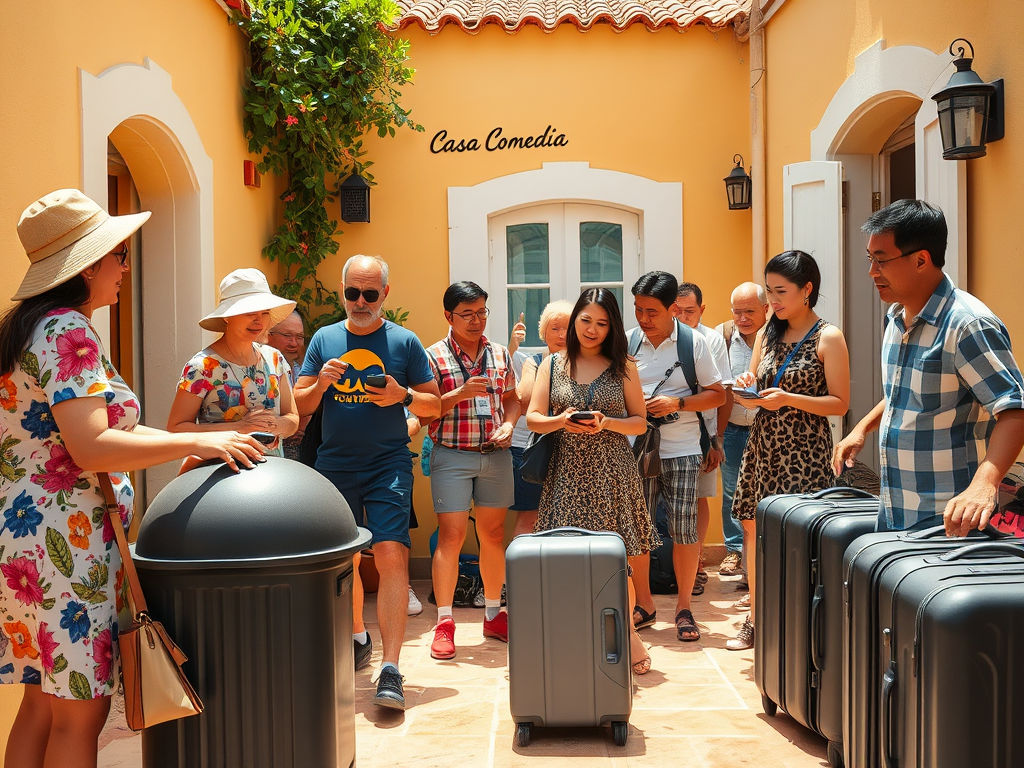

Agnes adjusted her floral-print bucket hat, the Spanish sun glinting off her sensible walking sandals. “Right, Brenda,” she declared to her wife, “we’re here for peace and quiet. No drama. Just sangria and scenery.”
Brenda, sporting a t-shirt proclaiming “I Survived the Midsomer Murders Fan Convention,” snorted. “Agnes, love, you know we attract chaos like a magnet attracts paperclips. It’s in our nature.”
They had envisioned a tranquil villa in the Andalusian countryside. Instead, they’d landed in a riot of international accents and bewildered expressions, all vying for space in the shared courtyard of “Casa Comedia.”
First, there were Chip and Tiffany from Iowa. Chip, sporting a baseball cap that read “Make America Grate Again” (over a picture of cheese), was attempting to grill hamburgers on a charcoal barbeque he clearly didn’t understand. Tiffany, in a skin-tight leopard print dress that seemed wildly inappropriate for rural Spain, was loudly complaining about the lack of ranch dressing.
“I swear, honey, these Europeans just don’t get it,” she drawled, fanning herself with a promotional fan from a bullfighting souvenir shop.
Next, the French-Canadian couple, Jean-Pierre and Marie-Claire, were engaging in a passive-aggressive battle over the proper pronunciation of “paella.” He argued vehemently for the Quebecois inflection, while she insisted on Parisian perfection. Their pronouncements, delivered with theatrical flair, punctuated the air like dueling baguettes.
Then came the Japanese couple, Hiroshi and Akari. They were painfully polite, bowing deeply to everyone and attempting to communicate with a phrasebook thicker than a telephone directory. They brought with them an impressive array of electronic gadgets, including a robot vacuum cleaner they kept tripping over and a device that supposedly translated animal sounds into conversational Spanish (it only seemed to confuse the local chickens).
Finally, the Koreans, a duo named Jin-woo and Soo-young, arrived lugging enormous suitcases filled with kimchi and instant noodles. They seemed perpetually lost, clutching a crumpled map and muttering to each other in rapid-fire Korean while staring at the villa’s sign, which, in fairness, was partially obscured by a rogue bougainvillea.
Agnes, who considered a good cup of tea a form of international diplomacy, decided to take charge. “Right,” she announced, clapping her hands together. “Let’s get organized. Chip, put down that charcoal before you set the olive grove on fire. Tiffany, darling, I’m sure the local supermarket has something resembling salad cream. Jean-Pierre, Marie-Claire, settle your differences over a glass of sherry. Hiroshi, Akari, perhaps we can find a volunteer to show you the local tapas bar. And Jin-woo, Soo-young, let’s see if we can decipher that map.”
Her attempts at order, however, were immediately undermined. Chip, attempting a daring maneuver with a pair of rusty tongs, managed to set his baseball cap alight. Tiffany, while inspecting the supermarket’s condiment aisle, mistook mayonnaise for yogurt and devoured a spoonful, resulting in a dramatic display of disgust. Jean-Pierre and Marie-Claire’s paella debate escalated into a full-blown theatrical performance, complete with dramatic gesticulations and passionate pronouncements on the merits of various saffron varieties. Hiroshi and Akari’s volunteer, Brenda, discovered a mutual love of murder mystery novels and spent the afternoon discussing Agatha Christie in hushed tones, leaving the Japanese couple even more bewildered. And Jin-woo and Soo-young, armed with Agnes’s limited Spanish and a lot of pointing, mistakenly ended up in a donkey sanctuary, where they were promptly swarmed by the affectionate, if somewhat persistent, animals.
Brenda, watching the unfolding chaos with a mischievous glint in her eye, turned to Agnes. “Told you, love. We’re walking, talking calamity.”
Agnes sighed, then a slow smile spread across her face. “Well, at least it’s not boring.”
That evening, Casa Comedia hosted an impromptu international feast. Chip, sporting a new, non-flammable hat, managed to grill the hamburgers to a passable level of edible. Tiffany, still recovering from the mayonnaise incident, grudgingly accepted a plate of gazpacho. Jean-Pierre and Marie-Claire, having momentarily declared a truce, contributed a quiche Lorraine (slightly burnt, but charmingly so). Hiroshi and Akari, having abandoned their gadgets for the evening, brought out a selection of exquisitely crafted origami animals. And Jin-woo and Soo-young, smelling faintly of donkey, offered a steaming pot of kimchi stew.
As the sun set, painting the Spanish sky in vibrant hues of orange and purple, the disparate group gathered around the courtyard table. They communicated in a fractured mix of English, Spanish, French, Japanese, and Korean, supplemented by generous helpings of gestures and laughter.
Agnes raised her glass of sangria. “To Casa Comedia,” she declared, “where peace and quiet go to die, but laughter thrives!”
Everyone cheered, even Tiffany, who had finally managed to secure a bottle of ranch dressing. The chaos hadn’t abated, but it had transformed into something… delightful. The peaceful holiday Agnes had envisioned had morphed into something far more memorable: a chaotic, hilarious, and utterly unforgettable Spanish adventure. Maybe Brenda was right, she thought. Maybe they were just born to attract chaos. And maybe, just maybe, they wouldn’t have it any other way.




Leave a Reply